
Nothing is more annoying than a harness that arrives and doesn’t fit. You wait, you try it on a wriggly dog, and then you start the return. Three quick measurements help a lot.
This guide shows you where to put the tape for a harness, a coat and a collar, how to read a size chart, and how to keep your dog’s numbers handy. It takes about five minutes.
Key Takeaways
- You need three numbers: neck, chest and back length. Each item uses a different mix of them.
- Measure your dog standing, on a flat floor. Keep the tape snug, with room for two fingers.
- Match your numbers to the product’s own size chart, not to breed or weight alone.
- Between two sizes? Size up, unless the listing says otherwise.
What You Need Before You Start
A soft tape measure is easiest. No tape? Use a piece of string, then hold it against a ruler. You’ll also want a pen, a few treats and, if your dog fidgets, a second pair of hands.
Put your dog on a flat floor, standing square on all four paws. A dog who sits or lies down bunches up their skin and shifts their weight, which throws the numbers off.
Want somewhere to write it all down? Grab our printable Dog Measurements Record Card (PDF). It has space for the numbers, the sizes you chose and a notes column.
Which Measurement Does Each Item Need?
Collars need one number. Harnesses and coats need two or three. Here is the short version.
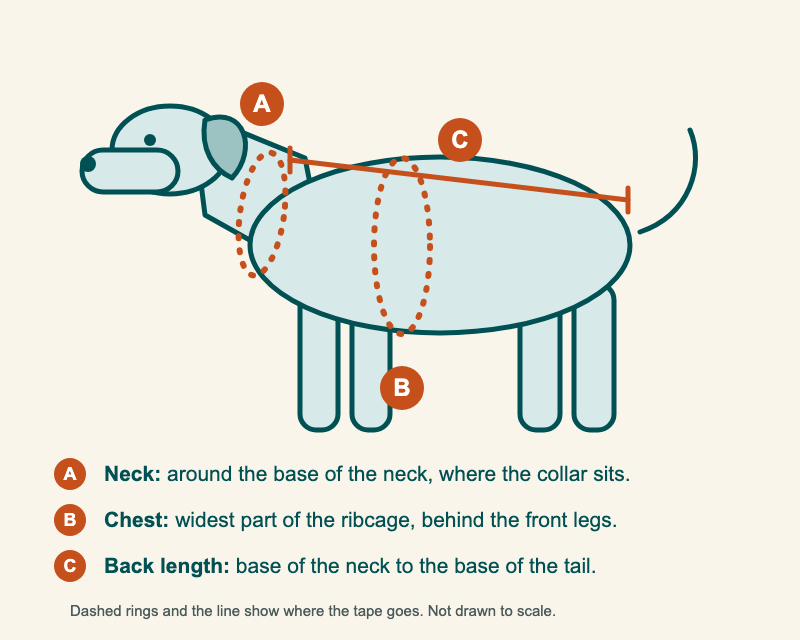
| Item | You need | Good to know |
|---|---|---|
| Collar | A. Neck | Add two fingers of room. |
| Harness | B. Chest and A. Neck | Chest is usually the one that matters most. |
| Coat | C. Back length and B. Chest | Back length usually decides the size. Chest decides how it closes. |
Not sure whether your dog needs a harness or a collar? Read harness vs. collar: which suits your dog.
How to Measure Your Dog’s Chest
Chest girth is the number most harnesses and coats are sized by. The American Kennel Club calls it typically the most important measurement for clothing and harnesses.
- Find the widest part of the ribcage. It’s usually just behind the front legs.
- Wrap the tape around the whole chest, over the back and under the belly.
- Keep it snug but not tight. You should be able to slide two fingers between the tape and your dog.
- Read the number where the tape meets itself, and write it down.
AKC gives the same advice: keep the tape snug but not tight, and use the two-finger rule.
Common Chest-Measuring Mistakes
- Measuring a sitting dog. The ribcage shifts and the skin bunches. Have them stand.
- Twisting the tape. Check it lies flat all the way around.
- Pulling too tight. A squeezed number gives you a harness that’s too small to wear.
How to Measure Your Dog’s Neck
Measure around the base of the neck, close to the shoulders. For most dogs that is where a collar normally sits. Leave room for two fingers so nothing rubs.
AKC says a collar needs only the neck measurement, with two fingers of room between the collar and your dog’s neck. For a harness, it adds extra room so the straps don’t pinch if your dog pulls.
Dogs With Long Necks
Dogs with long necks often wear a collar higher up, closer to the head. AKC says that for breeds with long necks, collars tend to sit higher on the neck.
A harness is different. AKC says to measure lower, between the withers and where a standard collar would rest. Take two neck numbers if your dog needs both a collar and a harness, and label them.
How to Measure Back Length for a Coat
For a coat, back length is usually what decides the size. A coat can’t be stretched lengthways, so it’s the number to get right first.
- Stand your dog up straight.
- Put the start of the tape at the base of the neck, where the collar usually sits.
- Run it along the top of the spine, in a straight line, to the base of the tail.
- Write the number down, then check the chest number against the size chart too.
Don’t follow the dip of the back with the tape. Keep it straight along the spine. If the coat has a neck opening or a belly strap, also note your neck and chest numbers.
Shopping for wet weather? Our guide to dog raincoats and how to size one goes further.
How to Read a Size Chart Without Guessing
Here’s the catch that trips people up. Some size charts list the dog the item fits. Others list the size of the item itself. AKC points out that some harnesses are sized by the dog’s measurements, while others are based on the dimensions of the harness.
A few ways to tell which you’re looking at:
- “Fits chest 18-22 in” usually describes your dog. Compare your number to that range.
- “Chest circumference 20 in” may be the item laid out flat. Your dog’s chest should be smaller, to leave room.
- Straps and fastenings add give. A fully adjustable harness is more forgiving than a coat with a fixed cut.
If the chart doesn’t say, ask before you order. Send us a message and we’ll help where we can.
What If Your Dog Is Between Sizes?
The usual advice is to go up. AKC says when in doubt, opt for the larger size, and for harnesses to look for adjustable options. The same rule usually applies to coats, unless the listing says otherwise.
Don’t rely on weight or breed alone. Dogs of the same breed come in very different builds.
Many items sold in our Walk & Travel and Clothing categories come in several sizes. Where a product has a size guide, you’ll find the link next to the size options on its page.
Write Down Your Dog’s Numbers
Take the numbers once, and you’ll save yourself the hunt for the tape next time. Put the date next to them, since bodies change.
Puppies grow fast, so measure again before every order. Adult dogs can change shape too, for example after a haircut or a change in their coat. If you’re ever concerned about your dog’s weight, ask your vet.
Download the Dog Measurements Record Card and print it, or keep the numbers in a note on your phone.
Check the Fit When It Arrives
Even a good measurement is worth checking on your dog. Here’s a quick fit test.
- You can still slide two fingers under the straps or collar.
- Nothing rubs under the front legs or around the neck.
- A harness doesn’t ride up toward the ears, and your dog can walk, sit and turn normally.
- A coat covers the back without dragging or pulling across the chest.
Supervise your dog the first time they wear something new. If it’s not right, our Returns & Refunds page explains what to do. Because items ship from overseas warehouses, the estimated delivery window is on every product page. A little care with the tape now saves you the wait for a swap.
Quick Answers
Should I measure over or under my dog’s fur?
Press the fur down gently and measure the body. Then keep the two-finger room on top. Not sure? Size up and check the listing.
What if my dog won’t stand still?
Use treats, and ask a helper to feed them while you measure. Short, calm tries work better than one long one.
Is the neck measurement the same for a collar and a harness?
For most dogs, nearly. Both go around the base of the neck. For long-necked dogs, a collar sits higher than a harness does, so measure each where that item will actually sit.
Do I measure in inches or centimeters?
Use whichever unit the size chart uses, and convert carefully if you need to: 1 inch is 2.54 cm.
The Short Version
Measure the chest, the neck and the back with your dog standing. Leave room for two fingers. Compare the numbers to the chart, and go up a size if you’re between two. Keep the numbers somewhere you can find them.
Give it a try, then browse the Walk & Travel category for harnesses, leashes and carriers in a size that fits.