
An indoor cat has no garden to patrol and no birds to watch. So the chasing, hiding and pouncing have to happen in your living room, and the right toys make that easy.
This guide picks five kinds of toys, plus a bonus food puzzle. For each one you’ll see what it’s for, who it suits and how to use it. We sell cat toys, but a few minutes of play with you counts for more than any gadget.
Key Takeaways
- Mix kinds of play: chasing with you, hiding, playing alone and scratching. Five of the same toy gets dull.
- Short play sessions work. International Cat Care says one minute of frenzied activity is a good result.
- End each game with a catch, so your cat doesn’t finish frustrated.
- Rotate two or three toys at a time to keep them interesting.
- Supervise play, and put string and feather toys away afterward. Ask your vet if your cat chews or swallows toys.
How to Pick Toys for an Indoor Cat
Start with what your cat is built to do. International Cat Care describes play as the full hunting sequence: search, stalk, chase, pounce and catch. It also warns that some games cause frustration when the pounce or catch is missing.
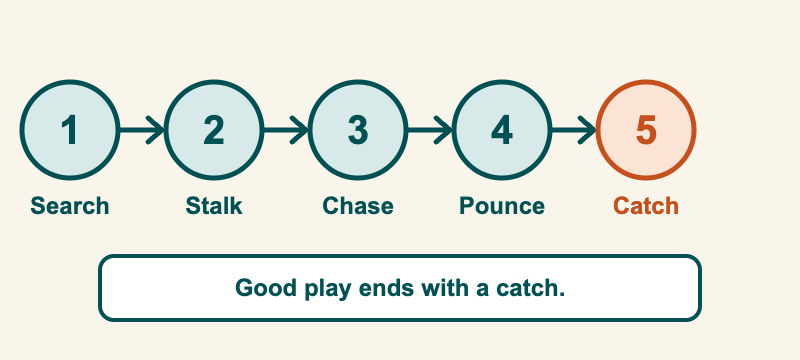
A good set of toys covers different steps. Here is the short version.
| Kind of play | What it gives your cat | Toy in this list |
|---|---|---|
| Chase with you | Stalking, chasing and pouncing together | 1. Teaser toy |
| Hide and explore | Ambushing and exploring | 2. Tunnel |
| Play alone | Batting and chasing when you are busy | 3. Ball tower, 4. Rolling ball |
| Scratch and bat | A place to scratch and swipe | 5. Spinning scratch toy |
| Search for food | Working for a few treats | Bonus. Food puzzle |
1. A Teaser Toy for Playing Together
Interactive play is the heart of it. International Cat Care says wand toys with a feather or a small toy mouse appeal to most cats. Move the toy in jerking, random movements, like real prey.
Our Suction Cup Retractable Cat Teaser Wand has a retractable line with a feather on the end. The base sticks to a smooth surface with a suction cup. It’s meant for play when you’re there, so supervise your cat.
A feather on a line is something to pick up afterward. Put the toy out of reach when you’re done. The University of Wisconsin vet school says cats that chew aggressively should avoid feathers and strings. Not sure about your cat? Ask your vet.
2. A Tunnel for Hiding and Pouncing
Cats love to hide, then burst out. A tunnel gives them both, and it works for a shy cat and a bold one. It also gives you something to pull a teaser through, which makes the game more fun.
The Collapsible Spring Cat Tunnel has a steel-wire frame that springs open for play and folds flat when you want the floor back. More than one cat can play at once. Pick the style you like, from plain colors to a mouse-and-feather version.
Want a free version? International Cat Care says cardboard boxes were “undoubtedly invented for cats”, and suggests a new box two or three times a week. Paper bags are among the safest cat toys, the Wisconsin vets add.
3. A Ball Tower for Playing Alone
You can’t play all day. A ball toy gives your cat something to bat while you work. The University of Wisconsin vet school lists ball-track toys among its ideas for solo play.
Our 4-Tier Cat Ball Tower Toy has four layers that hold six balls. A bell ball and two teasing rods sit on top, and non-slip pads keep it steady on the floor. The tiers come apart for storage.
Some cats ignore balls at first. Give it a few days, and keep it out when you aren’t home if your cat tends to chew. Remove any piece that gets chewed off.
4. A Rolling Ball That Chases Back
A toy that moves on its own makes a cat chase. That gives your cat the chasing step even when you’re busy.
The Rolling Silicone Cat Ball with Tail is made from silicone, and the tail gives your cat something to grab. It charges with the included Type-C cable. The page says to supervise play, so keep an eye on things at first.
A ping-pong ball is a simple option too. International Cat Care notes that it is light and the right size for a small paw.
5. A Spinning Scratch Toy
Scratching is normal cat behavior, and cats need a place to do it. A scratcher that moves can be more fun than one that sits still.
The Spinning Cat Scratch Toy, No Batteries has a felt scratch pad on top and spins 360° in both directions when your cat touches it. It needs no batteries. The listing gives its size as 6.5 × 25 cm (2.6 × 9.8 in).
A toy like this is a bonus, not a replacement for a sturdy scratching post. Our guide to what to buy before you bring a cat home explains what to look for in one.
Bonus: A Food Puzzle for Mealtime
Food puzzles make your cat work a little for a few treats. The University of Wisconsin vet school says puzzles and dispensers let cats “hunt” their daily food, but not to give too many treats.
Our Cat Puzzle Feeder with Sliding Lids and Treat Compartments is a flat board. Its lids, sliders and spinning wheel hide small treats or dry food. The listing shows five ways to play: flip, slide, sniff, push and spin. Non-slip rubber feet keep it still, and it’s top-rack dishwasher safe.
Start with an easy setup, with a few treats in the open compartments. Count the treats as part of your cat’s daily food. Ask your vet how much to feed.
Make Play a Routine
Cats are most active at dawn and dusk, so those are good times to play. Keep sessions short and let your cat win.
- Start with a teaser and a few minutes of chasing.
- Slow the toy down as your cat tires, then let them catch it.
- Finish with a food puzzle or a meal, then put the teaser away.
Rotate your toys. International Cat Care suggests keeping two or three on the go and giving your cat one at a time, to keep them new. Catnip works for many cats, but not all.
Laser pointers are fine for stalking and chasing, but your cat can’t catch the dot. International Cat Care suggests ending with a wand toy so the game finishes on a positive note.
Want a way to keep track? Download our printable Weekly Play Planner (PDF). It has tick boxes for each day, a spot for the week’s toys and room for notes.
Quick Answers
How many toys does an indoor cat need?
A handful, covering different kinds of play, is plenty. Keep a few out and rotate the rest.
Are feather and string toys safe?
They are fine for supervised play, then put them away. Cats that chew should avoid them. Swallowed string can be serious, so ask your vet if you are worried.
My cat ignores every toy. What now?
Try a different kind of play, such as a cardboard box or a moving toy, and play at dawn or dusk. If your cat’s behavior suddenly changes, ask your vet.
Can I leave toys out all day?
Simple toys like balls and tunnels, yes. Keep string and feather toys put away when you’re not playing.
The Short Version
Pick one toy for chasing with you, one for hiding, one or two for playing alone and one for scratching. Add a food puzzle if your cat likes to work for treats. Play a little every day, rotate the toys and end with a catch.
Ready to shop? Browse our Cat Toys or see everything in Cats. If something isn’t right, our Returns & Refunds page explains what to do. Questions first? Send us a message.