
A walk with your dog needs far less than the pet aisle suggests. A few well-chosen things cover most days, and the rest can wait until you know what you actually need.
This guide goes through the gear for walks and trips, from the harness to the car seat. Each section tells you what matters, and points to a deeper guide when there is one. We sell dog gear, but no gear replaces training and supervision.
Key Takeaways
- Most walks need five things: a harness or collar that fits, a leash, poop bags, water and ID.
- Fit matters as much as the type. Measure your dog first.
- A fixed-length leash gives you more control than a retractable one.
- Check hot pavement with your hand, and walk early or late in warm weather.
- A car trip needs its own secure setup. Never leave your dog alone in a parked car.
In this guide: The short answer · Harness or collar · Getting the size right · Leashes · Poop bags and water · Weather gear · Travel and car gear · What can wait · A checklist
The Short Answer: What You Need on Every Walk
Five things cover most walks. Everything else is optional.
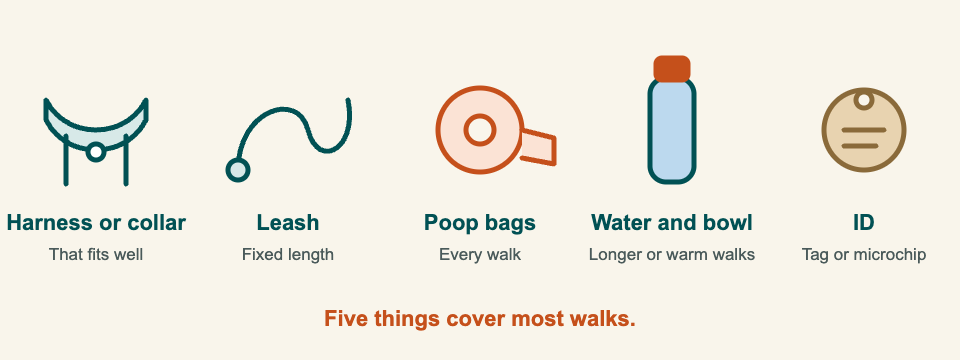
| Item | Why you need it | Can wait |
|---|---|---|
| Harness or collar | A secure way to attach the leash | Fancy styles |
| Leash | Control near roads and other dogs | Specialty leashes |
| Poop bags | Picking up after your dog | Extra holders |
| Water and a bowl | Longer or warm walks | Fancy bowls |
| ID | A tag, or a microchip from your vet | Trackers |
Want it on paper? Download our printable Dog Walk Checklist (PDF). It has tick boxes, a spot for your dog’s sizes and room for notes.
Harness or Collar?
Most dogs do well in a harness for walks and a collar for the ID tag. FOUR PAWS, an animal-welfare charity, calls a well-fitted chest harness the best everyday choice for most dogs. It says collars can be fine for calm leash-walkers and for holding ID tags.
The concern is pulling. When a dog pulls on a collar, the force lands on a small area of the neck. Small and flat-faced dogs, or dogs with airway or neck issues, are at higher risk. If that sounds like your dog, ask your vet.
- Our Reflective Dog Harness Vest is a vest-style chest harness for medium and large dogs. It comes in four sizes with a chest range of 45 to 105 cm (17.7 to 41.3 in). The leash is sold separately.
- Our Nylon Dog Collar with Adjustable Pin Buckle comes in three sizes. Sizes start at a 37 cm (14.6 in) neck, so it suits medium to large dogs.
Gear doesn’t teach loose-leash walking, whichever you choose. Our full guide, Harness vs. Collar: Which Suits Your Dog?, explains front-clip and back-clip harnesses, and when to use both.
Getting the Size Right
A harness or collar that doesn’t fit can rub, slip or pinch. Three measurements cover most gear: neck, chest and back length. The American Kennel Club’s guide to measuring your dog says to keep the tape snug but not tight, with room for two fingers.
- Collar: measure around the base of the neck.
- Harness: chest girth, at the widest part behind the front legs, is the key number.
- Coat: back length usually decides the size.
- Between sizes? Size up, unless the listing says otherwise.
Our step-by-step guide, How to Measure Your Dog for a Harness, Coat or Collar, shows where to put the tape. Keep the numbers on our printable Dog Measurements Record Card. Puppies grow fast, so measure again before every order.
Leashes: Fixed or Retractable?
For everyday walks, a fixed-length leash gives you the most control. You always know where your dog is, and you can shorten the distance quickly near roads and other dogs.
Retractable leashes are popular, and they have real drawbacks. A veterinarian writing for the Humane Society of Harrisburg Area lists several.
- A sudden stop at the end of the line can injure the neck of some dogs.
- The line can tangle around legs, or around other people.
- Dogs can learn to pull, because the line lets out when they do.
- You have less control if your dog darts toward traffic or another dog.
If you still want one, use it with care. Our Retractable Dog Leash for Medium and Large Dogs has a 5 m (16 ft) flat belt or an 8 m (26 ft) round rope. The product page says to lock it near roads and other dogs. It also says a fixed-length leash is the safer choice if your dog pulls hard.
Check any leash before you go. Look at the clip and the stitching, and replace it if it looks worn.
Poop Bags, Water and ID
These three are small, and they matter every walk.
- Poop bags. Carry more than you think you need. Our Foldable Poop Scooper with Bag Dispenser folds flat to clip to your bag. Some options include bags, so check the option you choose.
- Water and a bowl. Take water on longer or warm walks. Our Portable Dog Water Bottle holds 458 ml and has a wide opening for drinking. More choices are in Water & Travel.
- ID. A tag on the collar is quick to check. A microchip is another option, so ask your vet.
Weather Gear: Heat, Rain and Cold
Hot Weather
Pavement can get hotter than the air. The AKC’s guide to hot pavement and dog paws suggests a simple hand test. Place your hand comfortably on the pavement for ten seconds. If it’s too hot for your hand, it’s too hot for your dog’s paws.
- Walk in the early morning or evening, and avoid the hottest part of the day.
- Choose grass or shady paths when you can.
- Puppies’ paws are especially vulnerable.
- Boots can help if they fit snugly and your dog is used to them.
If your dog seems overheated or hurt, ask your vet.
Rain
A raincoat helps some dogs and bothers others. Try one on at home first. Our guide, Dog Raincoats: What to Look For and How to Size One, covers sizing and fit, and you can browse the Clothing category.
Cold Weather
Small, short-haired and older dogs may feel the cold more. Watch your dog, shorten the walk if they seem uncomfortable, and ask your vet if you are unsure.
Travel and Car Gear
A trip needs its own setup. A seat cover protects your car, but it doesn’t protect your dog. RSPCA Australia explains that dogs can be safely restrained in the back seat with a restraint or harness that has passed safety tests. Many products have not been crash-tested.
- A walking harness is not the same as a crash-tested vehicle harness.
- A crate needs to be secured in the car.
- Never leave your dog alone in a parked car, even for a minute.
- Plan breaks for toilet stops and fresh water.
Our guide, How to Keep Your Car Clean on Trips With a Dog, covers seat covers and a clean-up routine. Its Dog Car Trip Checklist (PDF) goes in the glove box.
For a small dog, a carrier can make outings easier. Our Breathable Dog Carrier Backpack for Small Dogs has a ventilated design and double shoulder straps. Choose the size by your dog’s measurements, and keep an eye on your dog while they are carried.
What Can Wait
You don’t need everything on day one. These are fine to add later, once you know your dog.
- A GPS tracker or a spare leash.
- Boots, unless hot pavement is a problem.
- A raincoat, if your dog doesn’t mind wearing one.
- A treat pouch. Small, soft treats are handy for rewarding good walking.
A Simple Checklist for Every Walk
- The harness or collar fits, with room for two fingers.
- The leash clip and stitching look sound.
- The ID tag is readable.
- You have poop bags.
- You have water, if it’s a longer or warm walk.
- The pavement passes the hand test.
Download the Dog Walk Checklist to keep by the door.
Quick Answers
What do I need for a first walk with a new dog?
A harness or collar that fits, a leash, poop bags, water and ID. Ask your vet about a microchip.
Is a harness better than a collar?
Many dogs do well in a harness for walks, with a collar for the ID tag. Our harness vs. collar guide goes through who each suits.
How long should a leash be?
Pick a fixed-length leash you can hold comfortably and shorten quickly. Very long leashes give you less control near roads.
Is it too hot to walk my dog?
Do the ten-second hand test on the pavement. If it’s too hot for your hand, wait, or walk early or late.
The Short Version
Start with a harness or collar that fits, a fixed-length leash, poop bags, water and ID. Measure first, check the pavement in warm weather, and set up the car separately. Add the rest when you know your dog.
Ready to shop? Browse our Walk & Travel category, or see everything in Dogs. If something doesn’t fit, our Returns & Refunds page explains what to do. Questions first? Send us a message.